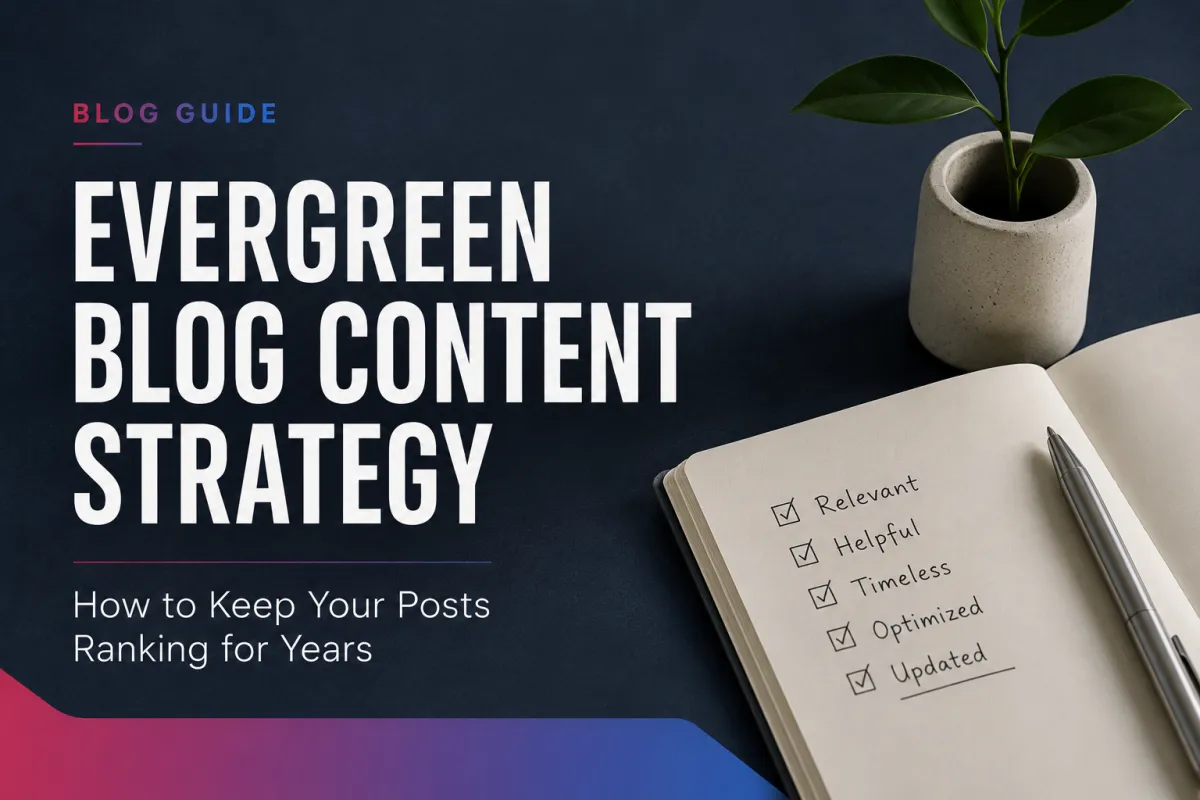
Evergreen Blog Content Strategy: How to Keep Your Posts Ranking for Years
Evergreen Blog Content Strategy: How to Keep Your Posts Ranking for Years
Publishing a blog post is only the beginning. The real value comes when that post keeps working for your business long after it goes live.
That is where evergreen blog content comes in.
Evergreen content is designed to stay relevant, useful, and searchable over time. Instead of chasing short-lived trends, it answers questions your audience will continue asking months or even years from now. For businesses that want consistent website traffic, better search visibility, and stronger brand authority, evergreen content is one of the most valuable long-term SEO assets you can build.
In this guide, we’ll break down what evergreen blog content is, why it matters, and how to create posts that continue ranking for years.
What Is Evergreen Blog Content?
Evergreen blog content is content that remains useful and relevant over a long period of time.
Unlike news articles, event announcements, seasonal promotions, or trend-based updates, evergreen content focuses on topics that people consistently search for. These posts usually answer common questions, explain core concepts, solve recurring problems, or guide readers through important decisions.
Examples of evergreen blog content include:
How-to guides
Beginner’s guides
Frequently asked questions
Checklists
Tutorials
Comparison articles
Best practices
Educational explainers
Step-by-step process articles
For example, a blog titled “How to Improve Your Website’s SEO” is more evergreen than “SEO Trends to Watch in 2026.” The first topic has long-term value, while the second may become outdated quickly.
Why Evergreen Content Matters for Long-Term SEO
A strong evergreen blog strategy helps your website earn traffic consistently over time.
When a post is properly researched, optimized, and maintained, it can rank in search engines for months or years. That means your business can continue generating website visitors, leads, and brand awareness without having to constantly publish new content every day.
For a company like System Management, evergreen content can help educate potential customers, answer common questions, and position your brand as a trusted resource in your industry.
Here’s why evergreen content is so powerful for long-term SEO:
1. It Creates Ongoing Organic Traffic
Evergreen topics are searched repeatedly. When your content ranks well, it can bring in steady traffic without relying on paid ads or social media promotion.
2. It Builds Authority Over Time
Helpful, timeless content shows search engines and readers that your website is a reliable source of information. The more quality evergreen posts you publish, the stronger your overall site authority becomes.
3. It Supports Lead Generation
Evergreen blog posts often target people who are actively searching for solutions. This makes them useful for attracting potential customers early in their decision-making process.
4. It Improves Content Longevity
Instead of creating posts that lose value after a few weeks, evergreen content stays useful with only occasional updates.
5. It Strengthens Internal Linking
Evergreen posts can become cornerstone resources on your website. You can link to them from service pages, newer blogs, landing pages, and email campaigns.
What Makes Blog Content “Timeless”?
Timeless content focuses on topics that do not expire quickly.
A timeless blog post usually has these qualities:
It answers a common, recurring question.
It solves a problem your audience regularly faces.
It is not tied too heavily to a specific date, event, or trend.
It can be updated easily when small details change.
It provides practical value no matter when someone reads it.
For example, a post about “How to Choose the Right Business Management Software” may stay useful for years if it explains core decision factors. A post about “The Best Business Management Software of May 2026” is much more time-sensitive and will require frequent updates.
That does not mean you should never write timely content. News, trends, and updates can still be valuable. But evergreen content should form the foundation of your blog strategy because it gives your website long-term staying power.
How to Build an Evergreen Blog Content Strategy
Creating evergreen blog content is not just about writing articles. It requires planning, keyword research, structure, optimization, and maintenance.
Here’s how to build a strategy that supports long-term SEO and content longevity.
1. Choose Topics Your Audience Will Always Care About
The best evergreen topics come from your audience’s ongoing needs.
Start by asking:
What questions do customers ask before buying?
What problems do they need help solving?
What concepts do they often misunderstand?
What decisions do they need guidance on?
What services or solutions do they research before contacting your company?
For System Management, evergreen blog topics may include business systems, process improvement, workflow management, automation, software organization, operational efficiency, and long-term digital strategy.
Possible evergreen blog ideas include:
How to Improve Business Workflow Efficiency
What Is System Management and Why Does It Matter?
How to Choose the Right Software for Your Business
The Beginner’s Guide to Business Process Automation
How Better Systems Help Businesses Scale
Common Workflow Problems and How to Fix Them
Why Organized Systems Save Businesses Time and Money
These topics are valuable because they connect to long-term customer pain points.
2. Focus on Search Intent
Search intent is the reason behind a person’s search.
Before writing a blog post, think about what the reader actually wants. Are they trying to learn something? Compare options? Solve a problem? Make a purchase decision?
For evergreen content, common search intents include:
Informational intent: The reader wants to understand a topic.
Commercial intent: The reader is comparing solutions.
Problem-solving intent: The reader needs help fixing an issue.
Decision-making intent: The reader wants guidance before taking action.
For example, someone searching “evergreen blog content” likely wants to understand what it is and how to use it. A strong blog post should explain the concept, show examples, and provide a practical strategy.
Matching search intent helps your content perform better because it gives readers exactly what they came for.
3. Use Keywords Naturally
Keywords help search engines understand what your content is about.
For this blog, the primary keyword is evergreen blog content. Supporting keywords include timeless content, long-term SEO, and content longevity.
A good evergreen SEO strategy uses keywords in important places, including:
Page title
Meta title
Meta description
URL slug
Introduction
Headings
Body content
Image alt text
Conclusion
However, keywords should sound natural. Avoid forcing the same phrase into every paragraph. Search engines are better at understanding context than they used to be, so your goal should be clarity and usefulness.
For example, instead of repeating “evergreen blog content” unnaturally, you can use related terms like:
Timeless blog posts
Long-lasting content
SEO-friendly content
Content that ranks over time
Long-term content strategy
This keeps the post readable while still supporting SEO.
4. Create a Strong Blog Structure
Evergreen content should be easy to read, scan, and understand.
A strong structure helps both readers and search engines. It also makes your content easier to update later.
Use a clear format like this:
Introduction
Definition or explanation
Why the topic matters
Step-by-step strategy
Common mistakes
Best practices
Conclusion
Call to action
Use descriptive headings that include relevant keywords when appropriate. Break up long sections with short paragraphs, lists, examples, and practical takeaways.
The easier your blog is to read, the more likely people are to stay on the page, engage with the content, and trust your business.
5. Write for Beginners and Decision-Makers
Evergreen content often attracts people who are early in the research process.
That means your writing should be clear, helpful, and easy to understand. Avoid assuming the reader already knows industry terms. When you use a technical phrase, explain it simply.
This is especially important for businesses that sell services, software, or system-based solutions. Your audience may know they have a problem, but they may not know the right terminology yet.
For example, a business owner may not search for “workflow optimization architecture.” They may search for:
How to save time in my business
How to organize business processes
How to automate repetitive tasks
How to manage business systems better
Evergreen content should meet readers where they are and guide them toward a solution.
6. Include Practical Examples
Generic content rarely performs well long term.
To improve content longevity, make your blog posts specific, useful, and actionable. Examples help readers connect the topic to their own situation.
For instance, instead of only saying, “Update your blog regularly,” explain what that looks like:
A business might review its top-performing blog posts every six months. During that review, it can update outdated statistics, improve headings, add new internal links, refresh examples, and make sure the call to action still matches the company’s current services.
That kind of detail makes the content more valuable.
7. Optimize for Featured Snippets
Featured snippets are short answers that appear near the top of Google search results.
Evergreen blog content is often a good fit for featured snippets because it usually answers common questions.
To improve your chances of earning snippets, include direct answers to common questions.
For example:
What is evergreen blog content?
Evergreen blog content is content that stays relevant and useful over time. It focuses on topics people continue searching for, such as how-to guides, FAQs, tutorials, and educational resources.
You can also use numbered steps, bullet lists, comparison tables, and short definitions to make your content easier for search engines to understand.
8. Add Internal Links
Internal links connect one page of your website to another.
They help search engines understand your site structure and help readers discover more useful content. For evergreen content, internal linking is especially important because these posts often become long-term traffic sources.
You can link evergreen blog posts to:
Service pages
Contact pages
Related blog posts
Case studies
Resource pages
Product or software pages
For example, if System Management has a service page about workflow automation, a blog post about improving business efficiency should link to that page naturally.
Internal links help turn blog traffic into business opportunities.
9. Keep Content Updated
Evergreen does not mean “set it and forget it.”
Even timeless content needs occasional maintenance. Search engines favor content that remains accurate, useful, and current.
To protect your rankings, review your evergreen blog posts regularly. A good schedule is every three to six months for high-priority posts and once a year for lower-priority posts.
When updating content, check for:
Outdated information
Broken links
Old screenshots
Weak examples
Missing internal links
Outdated calls to action
Changes in services or offers
Opportunities to add new sections
Keyword ranking changes
Refreshing old content is often faster and more effective than constantly creating new posts from scratch.
10. Avoid Dates That Make Content Feel Old
Dates can make a blog post look outdated, even if the advice is still useful.
For evergreen content, avoid unnecessary date-based language such as:
“This year”
“Recently”
“Today’s trends”
“In 2026”
“The latest update”
Instead, use timeless phrasing:
“A strong strategy includes…”
“Businesses often use…”
“One effective approach is…”
“A common mistake is…”
There are times when dates are necessary, especially for statistics, legal information, or software updates. But when possible, write in a way that keeps the content relevant longer.
Common Mistakes That Hurt Content Longevity
Even well-written blogs can lose rankings if they are not built correctly. Here are some common mistakes to avoid.
Writing About Topics That Are Too Trend-Based
Trend content may get quick attention, but it often fades fast. Balance timely posts with evergreen resources that support long-term SEO.
Ignoring Search Intent
A post may struggle to rank if it does not answer what the reader is actually searching for. Always review the intent behind your target keyword before writing.
Publishing Thin Content
Short, surface-level content usually does not provide enough value to rank for competitive terms. Evergreen content should be detailed enough to fully answer the topic.
Forgetting to Update Old Posts
Even timeless content can become outdated. Regular updates help protect rankings and improve user trust.
Not Linking to Business Goals
A blog post should help the reader, but it should also support your business. Include relevant calls to action that guide readers toward the next step.
Evergreen Blog Content Ideas for System Management
If System Management wants to build a strong evergreen content library, here are topic ideas that can support long-term SEO:
Business Systems and Operations
What Is System Management?
How to Build Better Business Systems
Why Every Growing Business Needs Organized Processes
How Poor Systems Cost Businesses Time and Money
Workflow and Productivity
How to Improve Workflow Efficiency
Signs Your Business Needs Better Workflow Management
How to Reduce Repetitive Tasks in Your Business
The Beginner’s Guide to Workflow Automation
Software and Automation
How to Choose the Right Business Software
What Is Business Process Automation?
Manual vs. Automated Systems: What’s Best for Your Business?
Common Automation Mistakes Businesses Should Avoid
Long-Term Growth
How Better Systems Help Businesses Scale
Why Process Documentation Matters
How to Create a More Efficient Business Operation
How to Build a Business That Runs More Smoothly
These topics can attract readers who are actively looking for ways to improve their business systems and operations.
How to Measure Evergreen Content Performance
To know whether your evergreen blog strategy is working, track performance over time.
Important metrics include:
Organic traffic
Keyword rankings
Average time on page
Click-through rate
Bounce rate
Internal link clicks
Leads or form submissions
Conversion rate
Backlinks
Returning visitors
Evergreen content is not always about instant results. Some posts may take time to rank. The goal is to build a library of content that compounds in value over months and years.
A post that brings in steady traffic every month can become far more valuable than a post that gets a short burst of attention and then disappears.
How Often Should You Publish Evergreen Content?
There is no perfect publishing schedule for every business.
A good starting point is to publish one to four high-quality evergreen blog posts per month, depending on your resources. Quality matters more than quantity. One well-researched, optimized, helpful post is more valuable than several rushed articles.
For many businesses, the best approach is a mix of:
Evergreen educational content
Service-focused content
Customer question content
Case studies
Industry updates
Seasonal or timely posts
Evergreen content should be the foundation, while timely content can support current campaigns and industry relevance.
Final Thoughts: Build Content That Keeps Working
Evergreen blog content is one of the smartest investments a business can make in long-term SEO.
Instead of creating content that quickly becomes outdated, evergreen posts continue helping your audience, supporting your rankings, and generating traffic over time. By choosing timeless topics, matching search intent, optimizing your structure, and updating posts regularly, your blog can become a long-term growth asset.
For System Management, an evergreen content strategy can help attract business owners, decision-makers, and teams looking for better systems, smoother workflows, and more efficient operations.
Strong content does more than fill your website. It builds trust, answers important questions, and helps potential customers understand why your solutions matter.


